The National Emblem
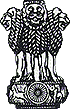
The National Emblem of India has an origin steeped in the culture and
myriad colors of India. A symbol of the modern Indian republic, the
emblem is an adaptation from the Sarnath Lion, capital of Emperor Ashoka
the Great as preserved in the Sarnath Museum situated near Varanasi in
the north Indian province of Uttar Pradesh.
The National Emblem of India is a near-replica of the Lion Capital of
Sarnath. The Lion Capital was erected atop a Pillar in around 250 BC by
Emperor Ashoka the Great to mark the spot where Buddha first preached his
Dharma (gospel of peace and emancipation) and where the Buddhist Sangha
was founded.
In the original Lion Capital of Emperor Ashoka, there stand four Asiatic
lions, back to back, mounted on a circular abacus with a frieze carrying
sculptures in high relief of an elephant, a galloping horse, a bull and a
lion separated by intervening wheels over a bell-shaped lotus. These
wheels stand for the "Ashoka Chakra" or "Dharmachakra" or the "Eternal
wheel of law" as mentioned in the Hindu scriptures. The whole of the Lion
Capital was carved out of a single block of polished sandstone.
The Indian National Emblem, modeled on the Lion Capital, features 3
lions. The fourth lion is hidden from sight since it is positioned at the
rear end; so is the bell-shaped lotus flower situated beneath. The frieze
beneath the lions is shown with a wheel in the center, a bull on the
right, a galloping horse on the left, and outlines of Dharma Chakras on
the extreme right and left. The wheel at the centre of the abacus
symbolizes the "Dharma Chakra".
The three lions (the one hidden from the front view excluded) represent
power, courage and confidence, and rest on a circular abacus girded by
four smaller animals that are separated by intervening wheels. These four
animals are the guardians of the four directions:
the lion of the north,
the elephant of the east,
the horse of the south and
the bull of the west.
The abacus rests on a lotus in full bloom, instancing the fountainhead of
life and creative inspiration. Inscribed below the emblem in Devanagari
script is the motto 'Satyameva Jayate' meaning "Truth Alone Triumphs". It
is a quote from the Mundaka Upanishad, the concluding part of the sacred
Hindu Vedas.
The Lion Pillar was adopted as the National Emblem of India on 26 January
1950, the day India became a republic.
The National emblem is used only for official purposes and commands the
highest respect and loyalty. It is the official seal of the President of
India and Central and State Governments. It forms a part of the official
letterhead of the Government of India. It also appears prominently on all
Indian currency as well as on the diplomatic and national Passport of the
Republic of India. The wheel on it, known as "Dharma Chakra" or popularly
"Ashoka Chakra", has even been placed onto the center of the modern
National Flag of India.
In the contemporary times, the national emblem of India stands as a
symbol of modern India's reassertion of its ancient commitment to world
peace and goodwill. To the 1 billion Indians, it serves as an inspiration
and is a matter of pride. To the world, it stands as glowing symbol of
independent India's identity and sovereignty.


 Mother's Day
 Passover
 Personal Finance Guide
 Multifaceted Blog
 Good Morning
 Dating