Karva Chauth
originated as a social and seasonal festival, but many mythical tales has been
added to it later. It is celebrated by the Hindus in north-western India.
The idea behind Karva Chauth is very sweet and noble. Earlier, girls sometimes
barely teenagers used to get married, go and live with their in-laws in very remote
villages. Everyone would be a stranger there for the new bride. In case she had
any problems with her husband or in-laws, she would have no one to talk to or
seek support from. Her own parents and relatives would be quite far and unreachable.
Telephones, buses and trains were not heard of in those days. People had to walk
almost a whole day to go from one place to other. Once the girl left her parent's
home for in-laws, she might not be back before long. Thus the custom started that,
at the time of marriage, when bride would reach her in-laws, she would befriend
another woman there who would be her friend (kangan-saheli) or sister (dharam-behn)
for life. It would be like god-friends or god-sisters. Their friendship would
be sanctified through a small Hindu ceremony right during the marriage. The bride's
friend would usually be of the same age (or slightly older), married into the
same village (so that she would not go away) and not directly related to her in-laws
(so there was no conflict of interest later). Emotionally and psychologically,
it would be very healthy and comforting for the bride to have her own 'relative'
near her.
Once the bride and this woman had become god-friends
or god-sisters, they would recognize their relation as such. They would treat
each other like real sisters. During any issues later in life, involving even
the husband or in-laws, these women would be able to confidently talk or seek
help from each other. Moreover, the bride's parents would treat her friend just
like their own daughter.
Thus Karva Chauth started
as a festival to celebrate this special bond of friendship between the brides
and their god-friends . The notion of praying and fasting for the husband came
much later and is secondary. It was probably added, along with other mythical
tales, to enhance the meaning of the festival. In any case, husbands would always
be associated with this festival, because the day of starting this friendship
between two god-sisters was essentially the day of bride's marriage to him. Hence
praying and fasting for him by his wife during a celebration of her relationship
with the god-friend would seem quite logical.
A few
days before Karva Chauth, married women would buy new karvas (spherical clay pots)
-- 7"-9" in diameter and 2-3 litres capacity -- and paint them on the
outside with beautiful designs. Inside they would put bangles and ribbons, home-made
candy and sweets, make-up items, and small clothes. The women would then visit
each other on the day of Karva Chauth and exchange these karvas.
Season-wise,
soon after the harvest, it is an excellent time to usher in the joys of festivities,
meet one another and exchange gifts. During Karva Chauth, parents also send gifts
(e.g., grains, food items and new clothes) to their married daughters and their
children. Grandchildren share a very special bond with their grandparents.
Karva
Chauth basically is once a year festival to renew and celebrate the relationship
between god-friends and god-sisters.
The Pooja Process followed
in Karwa Chauth
Karwa
is a festive ritual. It is observed by married women, its aim being the longevity
of women's marital life.
Observance of the first Karwa by the newly-wed is
a special occasion. A newly married woman is given utmost importance by her relatives
and immediate family members when she observes the fast for the long life of her
husband. She is showered with blessings of blissful married life and loads of
Karva Chauth gifts. As this festival
is considered very important for married women, all the symbols that reflects
the marriage
status of a woman is in high demand such as jewelery, bangles, henna, sarees, lehnga choli and many other traditional gifts.
First
Sargi Mother-in-law prepares an elaborate Sargi (the pre-dawn Karva Chauth
meal) when her daughter-in-law observes her first fast. She wakes up early to
prepare a sumptuous and lavish meal inclusive of sweets and other delicacies for
daughter-in-law. She blesses her daughter-in-law saying 'Sada Suhagan Raho'
which means, 'may you always enjoy a blissful married life' when the
latter touches her feet with reverence. She also presents her daughter-in-law
with gifts, which may be a piece of jewelry or a saree on the first Karva Chauth.
Baya Baya is a gift
given to a daughter's mother-in-law on the occasion of Karva Chauth. Mothers
of newly wed daughters bring gifts for all her family members. Some utensils are
also included in the baya which are to be distributed amongst women who join the
newly-wed on her first Karva Chauth Puja.
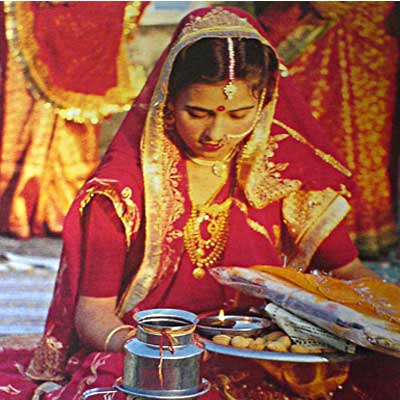 Observance of the first Karwa by the newly-wed is
a special occasion. A newly married woman is given utmost importance by her relatives
and immediate family members when she observes the fast for the long life of her
husband. She is showered with blessings of blissful married life and loads of
Karva Chauth gifts. As this festival
is considered very important for married women, all the symbols that reflects
the marriage
status of a woman is in high demand such as jewelery, bangles, henna, sarees, lehnga choli and many other traditional gifts.
Observance of the first Karwa by the newly-wed is
a special occasion. A newly married woman is given utmost importance by her relatives
and immediate family members when she observes the fast for the long life of her
husband. She is showered with blessings of blissful married life and loads of
Karva Chauth gifts. As this festival
is considered very important for married women, all the symbols that reflects
the marriage
status of a woman is in high demand such as jewelery, bangles, henna, sarees, lehnga choli and many other traditional gifts. 
 Mother's Day
 Passover
 Personal Finance Guide
 Multifaceted Blog
 Good Morning
 Dating