In Ireland
St. Patrick's Day is celebrated in towns and cities right across the
globe, but it's probably fair to say that nowhere can the festivities
match the excitement and atmosphere of St. Patrick's Day in Ireland.
In Ireland, St. Patrick's Day is more of a religious holiday similar to
Christmas and Easter. Many Irish people start the day by going to mass and
offering prayers for the Saint and missionaries all over the world. After
that people flock to their local village or town to see the annual Saint
Patrick's Day parade – and this is where the real celebrations begin! With
grand parades, community feasts, charity show, the mass, St Patrick's Day
is celebrated in Ireland with great gusto. The parades, shamrocks, and
green beer are provided primarily for tourists. In fact, it has turned out
to be one of the most celebrated events in Ireland and a major tourist
attraction.
Saint Patrick's Day is celebrated worldwide by the Irish people and
increasingly by many of non-Irish descent (usually in Australia, North
America, and Ireland), hence the phrase, "Everyone wants to be Irish on
St. Patrick's Day." Celebrations are generally themed around all things
green and Irish; both Christians and non-Christians celebrate the secular
version of the holiday by wearing green or orange, eating Irish food
and/or green foods, imbibing Irish drink (usually Guinness), and attending
parades.
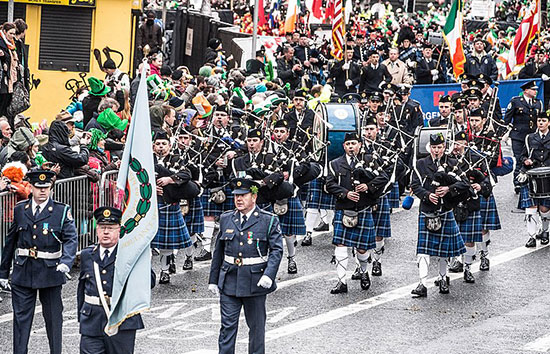
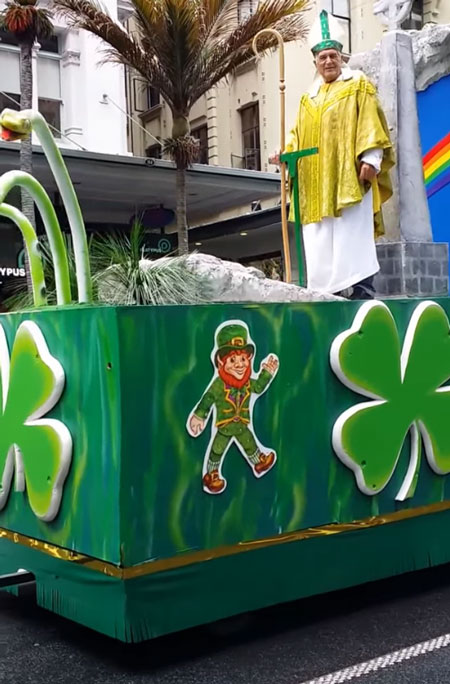
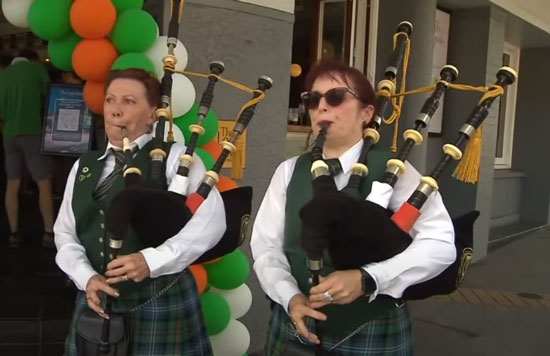
Saint Patrick's Day parades in Ireland date from the late 19th century,
originating in the growing sense of Irish nationalism. The St. Patrick's
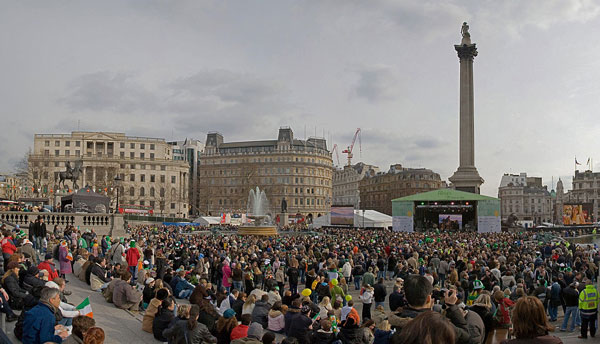
Day parade in Dublin, Ireland is part of a five-day festival; over 500,000
people attended the 2006 parade. With bands, music, dance, shamrock,
leprechauns, green coloured clothing and loads of power packed
performance, the Irish parade on Saint Patrick's Day is a sight to behold!
Almost everything in Ireland is closed on Saint Patrick's Day with the
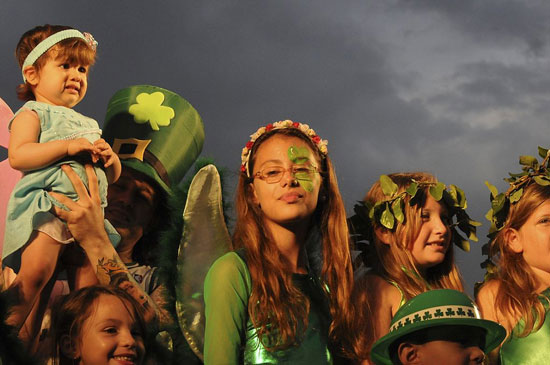
exception of pubs and restaurants. Many Irish people wear a bunch of
shamrocks ("three-leaf clover") on their lapels or caps on this day or
green, white, and orange badges (after the colors of the Irish flag).
Girls and boys wear green in their hair. Artists draw shamrock designs on
people's cheeks as a cultural sign, including American tourists.
The biggest celebrations on the island of Ireland outside Dublin are in
Downpatrick, Northern Ireland, where Saint Patrick was buried following
his death on 17 March, 461. In 2004, according to Down District Council,
the week-long St. Patrick's Festival had over 2000 participants and 82
floats, bands, and performers, and was watched by over 30,000 people.
The day is celebrated by the Church of Ireland as a Christian festival.
Saint Patrick's Day as a celebration of Irish culture was rarely
acknowledged by Northern Irish loyalists, who consider it a festival of
the Irish Republicans. The Belfast City Council recently agreed to give
public funds to its parade for the first time; previously the parade was
funded privately. The Belfast parade is based on equality and only the
flag of St. Patrick is supposed to be used as a symbol of the day to
prevent it being seen as a time which is exclusively for Republicans and
Nationalists. This allowed both Unionists and Nationalists to celebrate
the day together. The Unionists (orangemen) wear orange instead of green
on St. Patrick's Day; both colors are in the Irish flag (although this the
Irish flag is not an official flag in Northern Ireland, it being part of
the United Kingdom), and orange often but not always represents the
Protestants of Northern Ireland.
Outside Ireland
In the United Kingdom
The largest Saint Patrick's Day parade in the UK is held in Birmingham
over a two mile route through the city centre. The organisers describe it
as the third biggest parade in the world after Dublin and New York. Other
Saint Patrick's Day parades take place around the country including in
London where the largest minority community is Irish. The Lanarkshire town
of Coatbridge where the majority of the town's population are of Irish
descent also has a day of celebration and parades in the town centre. In
Birmingham, St. Patrick's Festival is one of the city's premier community
events, with the Irish community numbering around 140,000 people.
Manchester hosts a two week Irish festival in the weeks prior to St
Patrick's Day, not surprising giving that the city claims the largest
Irish population in Great Britain outside of London. The festival includes
an Irish Market based at the city's town hall which flies the Irish
tricolor opposite the Union Flag, a large parade (claiming to be the
biggest outside of Dublin and New York based on entrant and float numbers)
as well as a large number of cultural and learning events throughout the
two-week period. The festival promotes itself as the largest in the UK.
Florence, Italy
Around St. Patrick's Day, the city hosts 'Festa Irlandese' - ten days of
live music, food and drink. The event takes place in a huge tent and
attracts thousands of visitors who avidly consume the Italian
interpretation of Irish food and drink, including potato soup, beef in
Guinness, smoked salmon and gallons of stout.
Oslo, Norway
The Irish community in Oslo celebrates with a lively parade through the
city. Nearly a thousand people join in the fun as the parade steps off
through shopping streets, past Oslo cathedral, on to Town Hall Square for
some entertainment. Accompanying the pipe band are St Patrick, driven by a
red-bearded chauffer in a horse and cart, and a host of other colorful
Irish characters.
In Germany
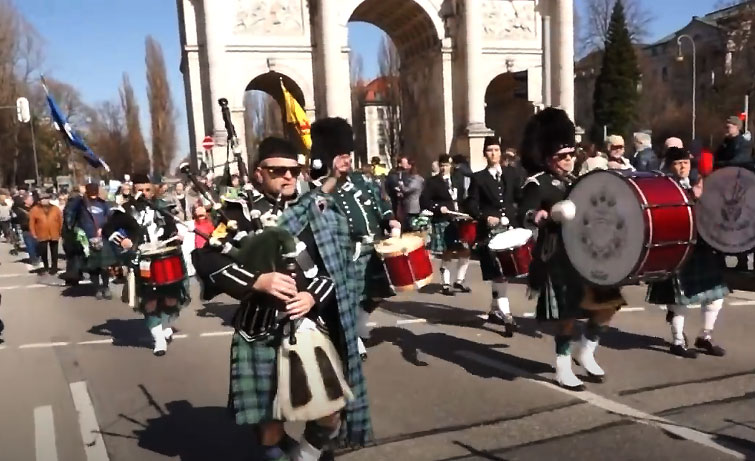
Munich is the only German city holding a St. Patrick's Day parade owing to
the considerably large Irish community. The parade is organized by the
German-Irish Society of Bavaria and has been held every year since 1996.
Meanwhile it has evolved into the largest in continental Europe and
features not only Irish/Scots/English, but also German clubs and
societies. Following the 2 km-parade, which usually takes place the Sunday
preceding 17 March, is an open air party with live music and dance
performances.
In Denmark
The St. Patricks Day 3 Legged Charity Race started in Copenhagen in 2001.
The race is organized by the Irish expert community and is sponsored by the
Carlsberg brewery and the Irish pub owners of Copenhagen. In 2007, the
event raised 26,000 DKK (~3,500 euro). All proceeds were donated to a
Danish charity for children with cancer. All proceeds from the 2008 race
will be donated to the Neonatal Department at Rigshospitalet, Copenhagen.
In Montserrat
The tiny island of Montserrat, known as "Emerald Island of the Caribbean"
due to its foundation by Irish refugees from Saint Kitts and Nevis, is the
only place in the world apart from the Republic of Ireland and the
Canadian province of Newfoundland and Labrador in which St Patrick's Day
is a public holiday. The holiday commemorates a failed slave uprising that
occurred on 17 March 1798.
In Russia
On March 15, 1992, thousands of Muscovites lined the Novy Arbat to witness
the first St. Patrick's Day Parade in the Russian capital's history. Yuri
Luzhkov - now the current Mayor of Moscow - and Aer Rianta Chief Executive
Derek Keogh were on the reviewing stand as a police escort led the way for
Russian marching bands, Cossack horsemen, and fifteen floats representing
many Russian companies. The parade, which was the brainchild of Derek
Keogh, was a big success, and ensured a repeat performance the following
year.
Each year the floats have become more numerous and sophisticated and the
range of international and Russian participants and sponsors more
wide-ranging such as Pepsi and Guinness. The local Irish bars of Moscow
contribute their own floats and Muscovites reveal their own homegrown
Irish Wolfhounds, which are nearly as big as the floats themselves.
The Moscow parade continued to be an annual event until 1998. The economic
collapse of August 1998 meant that the 1999 parade was canceled. In 2000
the St Patrick's Society of Russia managed to re-establish the St
Patrick's Day parade with the co-operation of the Moscow city government,
the Moscow police, various government bodies, the Irish embassy and the
Irish community in Moscow.
In South Korea
In Seoul, members of the expatriate community congregate on Daehakro (Taehongno),
and a small parade goes up the street and then down again. Parade members
include local expat sports teams, the Irish Community, and several Korean
marching bands. In 2007, the Marronier park near Daehakro was filled with
partygoers sampling Irish Stew and Guinness.
Tokyo, Japan
The tradition of holding parades is also upheld in Tokyo and every year
you can watch and participate in the parade on Omote Sando. The Tokyo
parade is organized by the Irish Network Japan (INJ) and was first held in
1992 with the support of the then Irish Ambassador to Japan, Mr. James
Sharkey. Various dignitaries from many countries participate in the parade
including the deputy prime minister of Ireland Mary Hearney in 2001.
About 2,000 participants march down fashionable Omotesando Avenue, lined
for the occasion by Irish and Japanese flags, cheered on by as many as
7,000 spectators. The Japanese love a good party and they are particularly
fond of all things Irish - including Guinness at about $7.00 a pint! There
are a growing number of Irish pubs that send attractive young ladies to
the parade for the sole purpose of handing out free beer vouchers. Not
surprisingly, the 'voucher girls' are a parade highlight!
In the United States
The early Irish immigrants like the English, Dutch, German, French and the
likes, brought their traditions in United States. But it was not until
1737 that the immigrants really celebrated the Day. Irish colonists
brought Saint Patrick's Day to what is now the United States of America.
During the first civic and public celebration of Saint Patrick's Day in
the 13 colonies, which took place in Boston, Massachusetts in 1737, The
Charitable Irish Society of Boston organized what was the first Saint
Patrick's Day Parade in the colonies on 17 March 1737. The first
celebration of Saint Patrick's Day in New York City was held at the Crown
and Thistle Tavern in 1756, and New York's first Saint Patrick's Day
Parade was held on 17 March 1762 by Irish soldiers in the British Army.
Held since 1762, the New York City parade on St Patrick's Day now draws
more than one million spectators each year. In 1780, General George
Washington, who commanded soldiers of Irish descent in the Continental
Army, allowed his troops a holiday on 17 March. This event became known as
The St. Patrick's Day Encampment of 1780. Today, Saint Patrick's Day is
widely celebrated in America by Irish and non-Irish alike.
In the US, Americans celebrate the holiday by wearing green clothing. Many
people, regardless of ethnic background, wear green-colored clothing and
items. Traditionally, those who are caught not wearing green are pinched.
Alcohol is the center of many American celebrations.
Some cities paint the traffic stripe of their parade routes green. Chicago
even dyes its river green. Savannah dyes its downtown city fountains
green. Indianapolis dyes its Central Canal green. University of Missouri
Rolla - St. Pat's Board Alumni paint 12 city blocks Kelly green with mops
before the annual parade.
Although the baseball season is still in the spring training phase when
St. Patrick's Day rolls around, some teams celebrate by wearing St.
Patrick's Day themed uniforms. The Cincinnati Reds were the first team to
ever wear St. Patrick's Day hats in 1978. The Boston Red Sox were the
second team to start wearing St. Patrick's Day hats in 1990. In 2004 the
Red Sox were the first team to wear jerseys specially designed for St.
Patrick's day. Since then it has become a tradition of many sports teams
to also wear special uniforms to celebrate the holiday. The Los Angeles
Dodgers also have a history with the Irish-American community. With the
O'Malley family owning the team and now Frank McCourt, the Dodgers have
had team celebrations or worn green jerseys on St. Patrick's Day. Other
teams celebrate by wearing Kelly green hats these teams include: the
Chicago Cubs, the Chicago White Sox, the New York Mets, the San Diego
Padres, the Atlanta Braves, the Pittsburgh Pirates, the Kansas City
Royals, the Seattle Mariners and the St. Louis Cardinals. Nearly all major
league baseball teams now produce St. Patrick's day merchandise, including
Kelly green hats, jerseys, and t-shirts.
In the United States, many people have also made the holiday a celebration
of the color green. These people, besides wearing green on that day, may
also stage dinner parties featuring all green foods. An example of such a
menu would be chicken with rice and lima beans with sliced green
maraschino cherries in coconut sauce colored with green food coloring, a
green salad including greens, avocados and sliced green apples, split pea
soup, green tinted bread spiced with sage, Lime Jell-O, iced limeade
and/or a green-beer, and lime pudding, key lime pie, or lime sherbet for
dessert. Corned beef and cabbage is the most common meal eaten in the
United States for St. Patrick's Day, even though historically, corned beef
and cabbage is an American (rather than a traditionally Irish) meal.
Perhaps the smallest notable parade, World's Shortest St. Patrick's Day
Parade is said to take place in Hot Springs, Arkansas in the United
States. Annually held on the historic Bridge Street the parade became
famous in the 1940s when Ripley’s Believe It or Not designated it “The
Shortest Street in the World.”
But Boulder, Colorado claims to have the shortest parade, which is also
less than a single city block.
In Canada
In Canada, Saint Patrick's Day is an official holiday only in the province
of Newfoundland and Labrador. Some groups, notably Guinness, have lobbied
to make Saint Patrick's Day a federal (national) holiday.
The longest-running Saint Patrick's Day parade in Canada occurs each year
in Montreal, Québec. The parades have been held in continuity since 1824;
however, St. Patrick's Day itself has been celebrated in Montreal as far
back as 1759 by Irish soldiers in the Montreal Garrison following the
British conquest of New France.
The Toronto St. Patrick's Day Parade is one of the largest in North
America. Since it began in 1988, the parade has grown to include 100
organizations, 32 Irish county associations, 2,000 marchers, 30 floats, 14
bands as well as an assortment of wolfhounds, leprechauns and talking
shamrocks.
In the Province of Manitoba, the Irish Association of Manitoba runs an
annual three day festival of music and culture based around St Patrick's
Day.
In Philadelphia
The Philadelphia St. Patrick's Parade is the 2nd oldest Parade in the
Country, topped only by the New York City Parade. The first documented St.
Patrick's Day Celebration Parade in Philadelphia was held in 1771, marking
over 230 continuous years of celebrations.
In Savannah, Georgia
Savannah, GA, boasts the unofficial record of having the largest
attendance in its St. Patrick's Day parade with the crowd count being
declared as a staggering 750,000 in 2006. Unlike other cities, the parade
in Savannah takes place on the actual day of Saint Patrick's Day; even if
that day is during the work week. However for 2008, the parade will take
place on Friday, March 14th, to honor Holy week in the Catholic faith. The
parade starts at Saint John the Baptist Catholic Cathedral on Abercorn
Street.
The actual parade route changes from year to year but usually
travels through Savannah's Historic Park District and Bay Street. Usual
participants in the parade include the local Armed Forces Units, Cadets
from Benedictine Military School, and other local organizations,
officials, and establishments. In 2006, the Deputy Prime Minister of
Ireland was featured in the parade. Since the parade travels through
Savannah's Historic Park District, one tradition that has developed has
been the official "dyeing of the fountains" which happens several days
before the parade. It has also become tradition for women spectators to
kiss the Armed Forces Units and other military organization's male
members.
The parade is not Savannah's only St. Patrick's day attraction. The
Savannah Waterfront Association has an annual celebration on Historic
River Street that is reminiscent of Mardi Gras on Bourbon Street. There is
no cover charge to access River Street, but a $5 wristband is required if
one chooses to drink there. Savannah does not have an open container law
so there is a proliferation of alcohol on River Street, Bay Street and in
City Market.
In Mexico
On these day, and on September 12, the Saint Patrick's Battalion (Batallón
de San Patricio) is memorialized. It fought as part of the Mexican Army
against the United States in the Mexican-American War of 1846 to 1848, and
was composed of several hundred Irish, Germans, Swiss, Scots and other
Roman Catholics of European descent.
Although it's not a popular holiday in Mexico, sometimes school children
hit, punch or slap anyone who is not wearing green in their clothes.
New Orleans, Louisiana
New Orleans has a parade that is strongly influenced by Mardi Gras. Unlike
most parades, where the participants staidly walk the parade route - with,
perhaps, an occasional display of Irish dancing, the parade at New Orleans
features floats, jazz bands and colorful costumed characters, with float
riders throwing spectators strings of beads, cabbages, and potatoes.
Syracuse, New York
The city of Syracuse, NY has a parade that culminates with the delivery of
green beer to Coleman's Irish Pub in the Tipperary Hill section of the
city and the painting of a shamrock in front of the pub. Tipperary Hill is
home to the World famous "Green-on-Top" Traffic Light. It is the Irish
section in Syracuse Historically. Syracuse boasts the largest St.
Patrick's day celebration per-capita in the United States.
New York City
The New York parade has become the largest Saint Patrick's Day parade in
the world. In 2006 more than 150,000 marchers participated in it,
including bands, firefighters, military and police groups, county
associations, emigrant societies, and social and cultural clubs, and it
was watched by close to 2 million spectators lining the streets.
The
parade marches up 5th Avenue in Manhattan and is always led by the U.S.
69th Infantry Regiment. It is the only New York City parade in which the
marchers head uptown instead of downtown. New York politicians - or those
running for office - are always found prominently marching in the parade.
Former New York City Mayor Ed Koch once proclaimed himself "Ed O'Koch" for
the day,[16] and he continues to don an Irish sweater and march every
year, even though he is no longer in office. In a similar fashion, new New
York state governor Eliot Spitzer marched in and even visited the morning
Mass at St. Patrick's Cathedral for the 2007 parade.
The parade is organized and run by the Ancient Order of
Hibernians.[citation needed] For many years, the St. Patrick's Day Parade
was the primary public function of the Ancient Order of Hibernians. On
occasion the order has appointed controversial Irish republican figures
(some of whom were barred from the U.S.) to be its Grand Marshal.
[citation needed]
While it is a popular misconception that the St. Patrick's Day Parade bans
'lesbians and gays', the fact is that essentially all politically
motivated groups, including pro-life groups, are banned from the Parade in
an effort to keep politics out of a festive community celebration. Gays
and lesbians are welcome to be in the Parade as members of any of the
groups allowed.
The New York parade is moved to the previous Saturday (16 March) in years
where 17 March is a Sunday. The event is also moved on the rare occasions
when, due to Easter falling on a very early date, 17 March would land in
Holy Week. This same scenario is scheduled to arise again in 2008, when
Easter will also fall on 23 March. In many other American cities (such as
San Francisco), the parade is always held on the Sunday before 17 March,
regardless of the liturgical calendar.
Seattle, Washington
Seattle celebrates St Patrick's Day in grand style, with a full week of
activities. Festivities kick off with the proclamation of Irish Week.
Due
to Seattle's northern state climates, like Ireland, the city received many
Irish immigrants. So many that Seattle and Galway are sister cities. Every
year on St. Patrick's Day, there's a mini-parade to prepare the parade
route with the ceremonial painting of a green stripe down the center of
4th Avenue. The day of the parade begins with a Catholic Mass for peace.
The Seattle Parade starts at 4th Avenue and Jefferson to the Reviewing
Stand at Westlake Park, ending officially at the Seattle Center. The
annual Irish Week Festival is enormous, including Irish step dancing,
food, historical and modern exhibitions, and Irish lessons. This is all
celebrated on March 14. And may be carried on till the 15, 16, and 17 of
March.
Las Vegas, Nevada
The Southern Nevada, (formerly Las Vegas) Sons of Erin has put on a parade
since 1966. It was formerly held on Fremont Street in downtown Las Vegas,
later moved to 4th street. Since 2005, the parade has been held in
downtown Henderson. It is one of the biggest parades in the state of
Nevada. It also consists of a three day festival, carnival and classic car
show in Old Town Henderson.
In Argentina
In Argentina, and specially in Buenos Aires, all-night long parties are
celebrated in designated streets, since the weather is comfortably warm in
March. People dance and drink only beer throughout the night, until seven
or eight in the morning, and although the tradition of mocking those who
do not does not exist, most people would wear something green.
In Buenos
Aires, the party is held in downtown street Reconquista, where there are
several Celtic bars ; in 2006, there were 50,000 people in this street and
the pubs nearby.
Despite all these varieties, the festivities all over the world are driven
by the same spirit. And why not? After all, everybody is Irish on St.
Patrick's Day. While it reminds us about St Patrick, the day is also a
celebration for being Irish and enjoying everything Irish. So make an
attempt to have the real fun of being Irish. Adorn yourself in green
clothing, pin the shamrocks, hunt for the leprechaun (well, not really),
cook and feast the Irish way, laugh away all worries with Irish jokes and
dance to the tunes of the Irish bands. Top o' the morning to ye!
|
|
|