
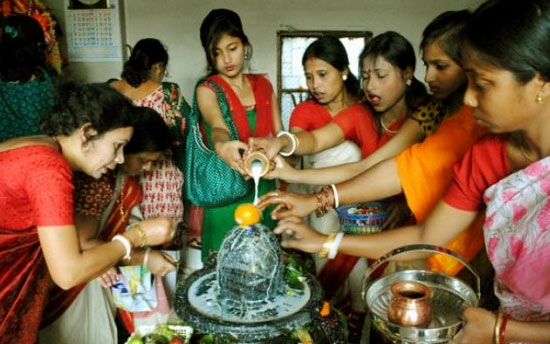
The Great Night of Shiva Celebrated on the new moon night in the month of Phalguna (generally falls in early March), and is dedicated to Lord Shiva. Observed especially by married women to ensure the long life of their husbands, it consists of a full day's fast and anointing the idol of Shiva with milk, water and honey.
Literally 'the great night of Shiva', celebrated on the moonless night of the month of Phalguna, which is fourteenth day in the dark half, this festival is specially dedicated to Shiva, the destroyer. This is an important day for the devotees of Shiva, who stay awake throughout the night, praying to him. In all major centers of Shivalinga worship, Shivaratri, also called Mahashivaratri, is a grand occasion. From the very early morning, Shiva temples are flocked by devotees, mostly women, who come to perform the traditional Shivalinga worship and hence hope for favours from the god. All through the day, devotees abstain from eating food and break their fast only the next morning, after the night-long worship.
How the Lord is worshipped:
Devotees bathe the Shivalinga with milk especially auspicious for women. According to one myth, Parvati performed tapas, and prayed and Parvati meditated on this day to ward off any evil that may befall her husband on the moonless night. Since then, Mahashivaratri is also believed to be an auspicious occasion for women to pray for the well-being of their husbands and sons. An unmarried woman prays for a husband like Shiva, who is considered to be the ideal husband. Devotees bathe at sunrise, preferably in the Ganga, or any otherholy water source (like the Shiva Sagartank at Khajurao). They offer prayers to the sun, Vishnu and Shiva. This is a purificatory rite, an important part of all Hindu festivals. Wearing a clean piece of clothing after the holy bath, worshippers carry pots of water to the temple to bathe the Shivalinga. The temple reverberates with the sound of bells and shouts of “Shankerji ki Jai” or 'Hail Shiva'. Devotees circumambulate the linga, three or seven times, and then pour water over it. Some also pour milk. According to a legend in theRamayana, once King Bhagiratha left his kingdom to mediate for the salvation of the souls of his ancestors. He observed a penance to Brahma for a thousand years, requesting Ganga to come down to earth from heaven. He wanted her to wash over his ancestors' ashes to release them from a curse and allow them to go to heaven. Brahma granted his wish but told him to pray to Shiva, who alone could sustain the weight of her descent. Accordingly, Ganga descended on Shiva's head, and after meandering through his thick matted locks, reached Shivaratri Ganga meandered through Shiva's hair before she was led by Bhagiratha to wash over the ashes of his ancestors the earth. According to a modified version, what reached the earth was just sprinkles from his hair. This story is believed to be re-enacted by bathing the linga. The love of water, the primary element of life, is also remembered in this ritualistic action. The linga is bathed with milk, water and honey. It is then anointed with sandalwood paste, vermillon, etc. People offer wood apple or bel leaves and fruit, milk, sandalwood and jujube fruit or ber to the linga. Shiva is believed to be very hot tempered, and hence things which have a cooling effect are offered to him. People decorate the linga with flowers and garlands and also offer incense sticks and fruit. In bigger temples, there is almost a stampede as devotees seek favours from the beloved god. Many also employ the services of a priest to perform special prayers. According to the Shiva Purana, the Mahashivaratri worship must incorporate six items:
Bathing the Linga with water, milk and honey, and Wood apple or bel leaves added to it, representing purification of the soul;
These six items, till today, form an indispensable part of Mahashivaratri, be it a simple ceremony at home or a grand temple worship. By offering water, hugging the linga, lighting the diya and incense, and ringing the temple bells, devotees call To protect the world from annihilation.
Om namo hiranya bahade
hiranya varnaya
hiranya roopaya
hiranya pataye
Ambika pataya
Uma pataye
Pashupataye Namo Namaha
Ishana Sarvavidyanam
Ishwara Sarvabhutanam
Brahmadhipati
Brahmanodhipati
Brahma Shivo me Astu Sada Shiv Om
Tatpurushaya vidmahi
Vakvishudhaya dhimahi
Tanno Shiva Prachodayaat
Oho devaya vidmahi
Rudramurtaye dhimahi
Tanno Shiva Prachodayaat
Namaste Astu Bhagavan
Vishweshvaraya
Mahadevaya
Trayambakaya
Tripurantakaya
Trikagnikalaya
Kalagnirudraya
Neelakantaya
Mrityunjayaya
Sarveshvaraya
Sadashivaya
Shriman Mahadevaya Namaha
Om Shanti
 Mother's Day
 Passover
 Personal Finance Guide
 Multifaceted Blog
 Good Morning
 Dating