
Buddha suggested a Middle course to be adopted by his followers for leading a peaceful life. And avoids the two extremes of self-indulgence and self-mortification. Self-indulgence pursues to the desires of the heart and give in to earthly temptations. While, self-mortification is based on living without feelings and without enjoyment of any kind.
To him neither way is right. He preached for a third way, a middle path. The path that is based on the principle of moderation.
Be kind to all other people
Do not harm living creatures of any kind
Help people less fortunate than yourself
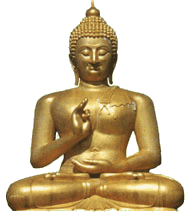
Buddhism is based upon four noble truths:All human conditions lead to suffering;Suffering has a cause;That cause is craving,or, desire, or thirst;There is a path for the cessation of suffering.Called the Eight Fold Path, it consists of
right belief, right thought,
right speech, right action,
right livelihood, right effort,
right mindfulness, and right meditation.
Buddhism believes that a person can begin to move in the right direction by taking total 'refuge'. That is by making a confession of faith in the Buddha, his teachings, and his monastic order. And, also, by adopting five fundamental moral precepts:
not to lie,
not to deprive a living thing of life,
not to take what is not given to you,
not to engage in illicit sexual conduct,
and
not to take intoxicating drinks.
These prohibitions along with other teachings help achieve the ultimate goal of life. According to Buddhism, this goal is called Nirvana, a state of peace and freedom from the cycle of birth is said to be the goal of life.
The Wheel of Law or dharmachakra, is the most important symbol ofthe religion. This, according to Buddha, is the law that ensures the welfare of the greatest number of people if practiced faithfully. The wheel symbolizes the goodness in every person.
In the larger sense, it is the wheel of eternity and cosmic reality, which underlines all changes in the universe. The wheel has eight spokes representing the eight virtues enumerated by the Eight Fold Path, the path to salvation.
The Tripitika or the three baskets comprises the sacred literature of the Buddhists in the Theravada school. It is divided into three parts, the Vinaypitaka, the Suttapitaka and Abidharmapitaka.
And although Buddhist worship was originally not very ritualistic, with time a certain format has been established. After the passing away of the Buddha, the Buddhist order came to be divided. As many as 18 schools of thoughts developed, each interpreting the words of the Buddha in their own way.
Theravadas and Mahayanas are two of these schools. Theravada means 'doctrine ofelders'. The aim of Thervada is to realise Nirvana through the triple recourse: ethical conduct, mental discipline, and higherknowledge or wisdom.
The ideal of Mahayana is Buddhahood. Followers of this school believe that Buddha taught universal salvation. Mahayana literally means the 'great vehicle' which takes one to enlightenment.The Mahayanis consider the aim of Theravadas to seek personal nirvana, as a lower aim. This is why they call it Hinayana which literally means 'lesser vehicle'. However, this philosophy is considered earlier and more original by many scholars.
The Mahayana sect has its own sacred scripture in the Mahayana Sutras. Also called the Vaipulya Sutras, it is an introduction to Buddhism contains Buddha's sermons delivered at various places during his earthly career. The most important scripture of the Mahayanas is the Prajnaparamita Sutra.
Looking for Something? Search Google :
 Mother's Day
 Passover
 Personal Finance Guide
 Multifaceted Blog
 Good Morning
 Dating